Procurement & Frameworks
Transporting Medical Equipment: A Planning Guide
The vehicle is almost never what goes wrong. It is the lift that is four centimetres too shallow, and the engineer nobody booked.
OMS Clinical Team
Product Specialists
Procurement & Frameworks
The vehicle is almost never what goes wrong. It is the lift that is four centimetres too shallow, and the engineer nobody booked.
OMS Clinical Team
Product Specialists

Moving a piece of medical equipment looks like a transport problem and is almost never solved by thinking about transport. The vehicle is the easy part. What derails a move is a lift car four centimetres shallower than the couch, a fire door that opens the wrong way, an engineer nobody booked, or an insurance policy that turns out to exclude the exact category of thing being carried.
This is the planning that has to happen before anyone quotes you a price. Work through it and most moves become routine. Skip it and you find out on the day, when a crew is standing in a corridor being charged by the hour.
Not a vague list. For each item you need the real weight, the real dimensions including anything that protrudes, whether it is calibrated, and what it is worth to replace. Manufacturer spec sheets give the shipping weight of a new unit, which is often not the weight of the same unit with a battery, a trolley and a full consumables drawer.
Calibration status matters more than value here. A calibrated instrument that arrives out of calibration has not arrived. It needs recalibrating before it goes back into service, and if the paperwork does not exist your quality system has a hole in it. Flag those items early so the handling and the post-move checks are planned rather than remembered.
The single most common cause of a failed move is a measurement nobody took. The item fits the destination and does not fit something between the two. Measure the narrowest point on the whole path, at both ends, and write the numbers down.
Lifts deserve particular attention. A passenger lift has three constraints and people usually check one: the door opening, the internal car depth, and the weight limit. An examination couch that clears the doors can still be too long for the car, and a lift rated for eight people will not take a heavy imaging unit plus two handlers.
This is where moves stall, and it is entirely avoidable. A lot of medical equipment cannot be disconnected and reconnected by a handler, a porter or a general engineer. It needs the manufacturer, an authorised service partner, or someone with a specific qualification, and the warranty often says so explicitly.
Establish for each item who decommissions it, who recommissions it, and whether that person needs booking weeks ahead. Then sequence the move around their availability rather than the vehicle's. A transport crew can be rebooked in days. A manufacturer engineer often cannot.
Goods-in-transit cover is not one thing. It has a limit per consignment, and it has exclusions. Both matter, and people usually discover both after something has gone wrong.
The limit is often set at a level that is generous for pallets of consumables and nowhere near the value of a single diagnostic unit. Medical and scientific equipment is also a commonly excluded category in standard policies, which means the cover you assumed applies may not apply at all. Ask for the figure and the exclusions in writing, and declare the value before the job rather than after.
There is no legal maximum lifting weight in the UK. This surprises people, because the figures of 25kg for men and 16kg for women are quoted so often that they have hardened into rules. They are not limits. They are risk filters in HSE guidance, applying only to a compact load held close to the body at about waist height in good conditions, used to decide when a fuller assessment is needed.
What the Manual Handling Operations Regulations 1992 actually require is that hazardous manual handling is avoided where reasonably practicable, that anything remaining is assessed, and that risk is reduced as far as reasonably practicable. The assessment considers the Task, the Individual, the Load and the Environment. A 20kg monitor carried down three flights of stairs by one person can be a worse risk than a 40kg unit moved twenty metres on a level floor with a skate and two people.
In practice this means the answer to the question can two people carry it is not a number. It is whether the route, the grip, the posture and the people make that a sensible way to move it, or whether it wants a skate, a stair climber or a tail lift.
If a tail lift is involved, it is lifting equipment and falls under the Lifting Operations and Lifting Equipment Regulations 1998. It needs thorough examination by a competent person, and the interval depends on what rides on the platform: every twelve months where it lifts goods only, and every six months where it lifts people.
That distinction is worth knowing, because a handler standing on the platform steadying an item is the six month case, not the twelve month one. It is a fair question to ask any transport supplier, and the answer tells you something about how the rest of the operation is run. Reports are statutory documents and are kept for at least two years, so a supplier who cannot find the last one is telling you something.
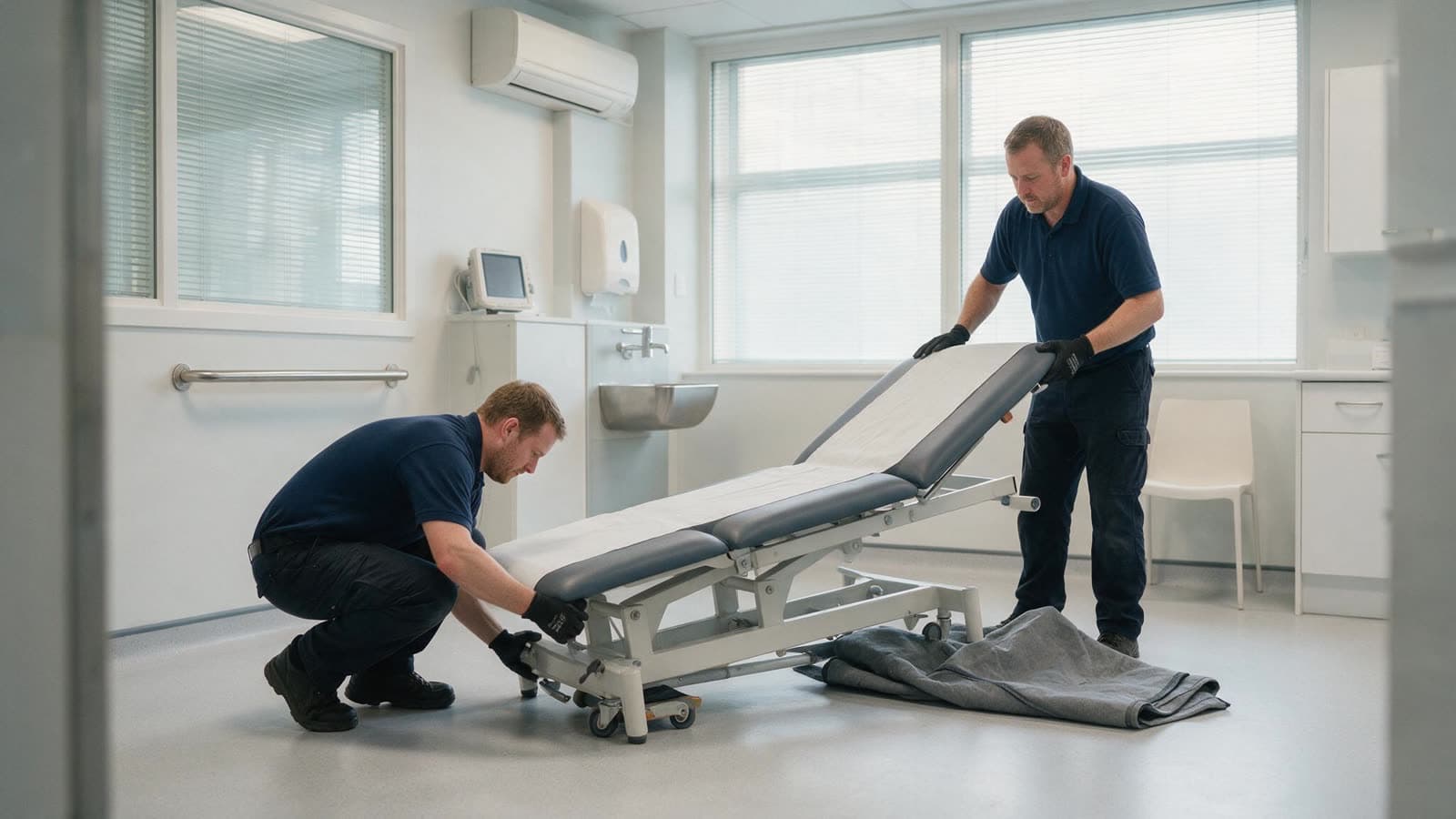
Most damage happens because an item travelled resting on its own castors, or because nothing stopped it moving sideways under braking. Neither is fixed by wrapping.
You can reasonably remove and pack loose parts yourself: probes, cables, trays, drawers, anything that will slide or swing. Bag them, label them against the parent item and keep them with it. What you should not do is improvise restraint in the vehicle. Load restraint is rated equipment used a specific way, and a ratchet strap over an unsupported panel does more harm than no strap at all.
Agree the sequence in advance and put one person in charge of it on site. Not a committee, one name and one phone number. The commonest day-of failure is a crew waiting because nobody present has authority to decide whether an item can come out yet.
Confirm access before anyone travels: barrier codes, loading bay booking, who holds the keys, and whether the building needs the crew signed in or escorted. Clinical spaces often need the move fitted around activity, which is why so many run out of hours or across a weekend. That is a scheduling constraint to plan for, not an obstacle.
The move is not finished when the vehicle leaves. Calibrated items need their post-move checks, recommissioning needs booking, and the paperwork needs filing while everyone still remembers what happened.
Compare the arrival photographs against the pre-move set before signing anything. A signature on a delivery note without that comparison makes any later claim considerably harder, and the two minutes it takes is the cheapest insurance in the whole exercise.
Weigh and measure the items. Measure the tightest point of the route at both ends, including the lift car depth and its weight limit. Find out who is allowed to disconnect what, and book them first. Get the insurance limit and exclusions in writing. Let the crew do the restraint. Photograph everything before and after. Put one person in charge on the day.
None of that costs anything. It is the difference between a move that is boring and a move that becomes a story.
If you would rather hand the whole thing over, our medical equipment transport service covers the survey, the crew, the restraint and the paperwork. Either way, the planning above is what determines whether the day goes smoothly.