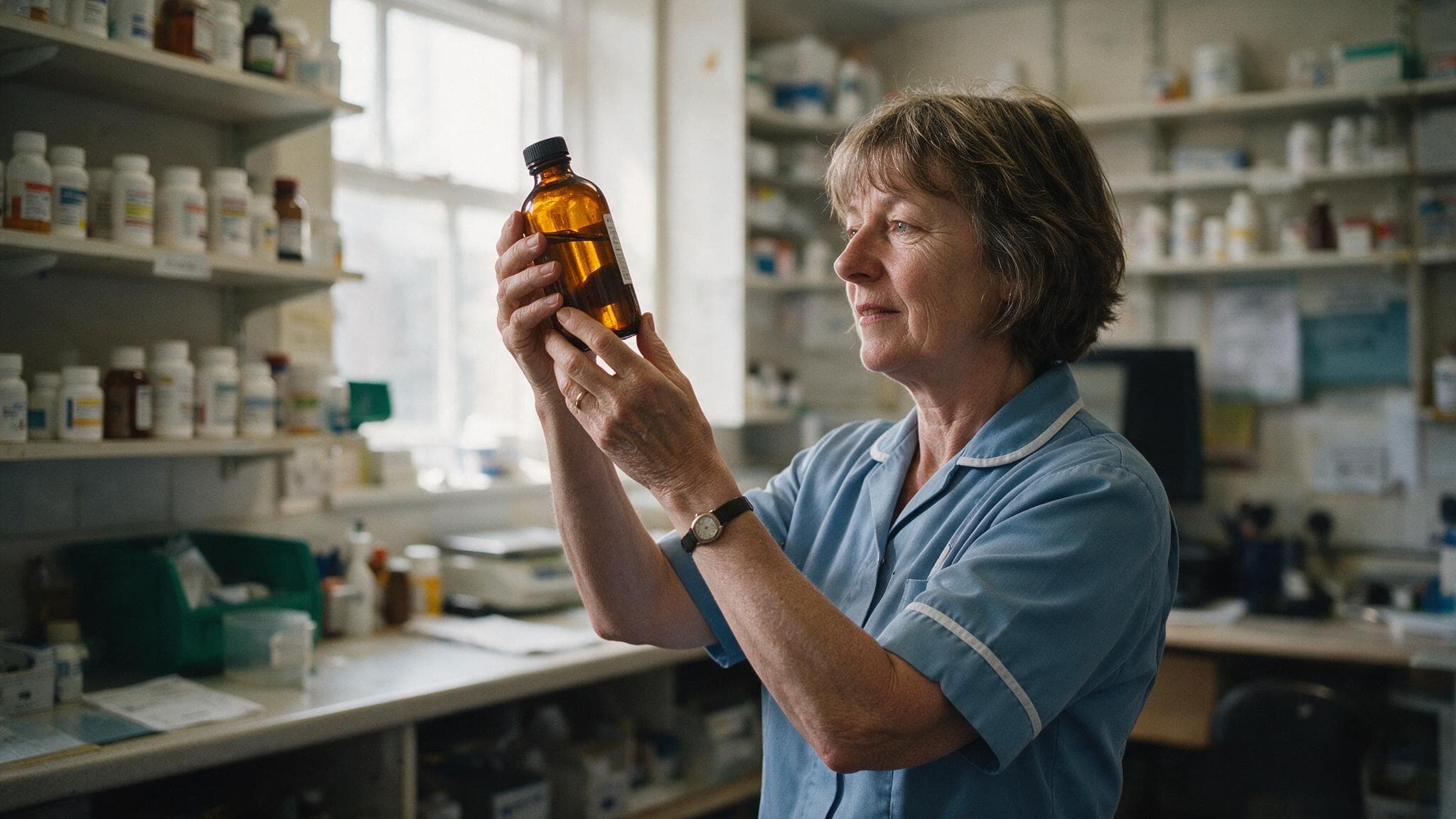
Amber glass filters ultraviolet and short-wavelength visible light, roughly below 470 nanometres. That is the band which degrades many light-sensitive preparations. Clear glass and most clear plastics let it straight through, which is why a light-sensitive liquid in a clear bottle can lose potency on a sunny windowsill.
What amber glass actually does
The colour comes from iron, sulphur and carbon added to the melt, not from a coating. That matters because it cannot rub off or scratch away, and the protection is the same on the inside of the bottle as the outside. A brown plastic bottle achieves a similar effect with pigment, and the performance varies more between manufacturers.
It is worth being precise about the limits. Amber glass reduces light transmission in a specific band. It is not opaque, it does not block heat, and it does nothing about oxygen ingress. A preparation that degrades through oxidation needs a good closure and a full bottle, not a darker one.
Which preparations need it
Preparations the manufacturer or formulary specifies as light-sensitive
Many vitamins, particularly A, B2, B12 and K
Some antibiotics in liquid form
Essential oils and tinctures, where the active constituents are readily degraded
Anything you are storing for an extended period rather than dispensing immediately
If a preparation is going out today and will be used within a fortnight in a kitchen cupboard, the case for amber is weaker than for something sitting on a dispensary shelf for months under fluorescent light.
Amber glass or amber plastic
Glass is inert. It will not leach, it will not absorb the preparation, and it will not soften with solvents. That makes it the safer default for anything you are unsure about, and the only sensible choice where a preparation contains alcohols or oils that would attack plastic.
Plastic wins on weight, on breakage and on cost. For a care home, a domiciliary delivery or a patient with reduced dexterity, a dropped glass bottle is a genuine hazard and a plastic one is the better clinical decision even if it is theoretically less inert.
Amber glass for solvent-containing preparations, long storage, and anything specified as requiring glass
Amber PET or polypropylene for general dispensing, deliveries and anywhere breakage is a real risk
Clear containers only where the preparation is not light-sensitive, or where seeing the contents genuinely matters
What BS1679 says about it
BS1679, the British Standard for containers for pharmaceutical dispensing, includes light transmission requirements. A bottle sold as meeting BS1679 has been made to those limits. If light protection is the reason you are buying amber, that standard is the thing to ask about rather than simply the colour.
Practical points
Store amber stock away from the window in the dispensary as well. It is easy to protect the patient and forget the shelf. Keep amber and clear bottles of the same size visually separated, because under dispensary lighting a hurried hand reaches for the nearest one.
If you decant into amber for light protection, do it promptly rather than leaving the preparation in a clear intermediate container while you finish something else.
How light damage actually shows
Photodegradation rarely announces itself. A liquid may darken slightly, or develop a faint haze, or show no visible change at all while the assay has dropped. That is the awkward part: you cannot inspect your way to confidence. The protection has to be built in at the point of packing rather than judged later by eye.
Where you do see a change, treat it as a signal that the whole batch has had the same exposure, not that one bottle was unlucky. If one bottle on a shelf has discoloured, the others beside it have had the same light dose.
A worked example
A dispensary supplies a light-sensitive oral liquid in 200ml quantities, roughly forty a month, and holds unopened stock for up to eight weeks. The bench sits two metres from a south-facing window. Here amber glass is the right call for the dispensed bottles and the bulk stock should be moved off that bench entirely. The window is doing more damage to the shelf stock than to anything that leaves the building.
Change one variable and the answer changes. If the same product turned over in three days and never sat in stock, the container choice would matter less than where the box was kept.
Questions worth asking a supplier
Is the container made to BS1679, and can you provide evidence
For plastic, what pigment system is used and what light transmission has been measured
What neck finish does it take, so closures can be ordered to match
Is the amber consistent between production runs, which matters if you are matching existing stock
Frequently asked questions
What does amber glass protect medicines from?
Ultraviolet and short-wavelength visible light, roughly below 470 nanometres, which is the band that degrades many light-sensitive preparations. It does not block heat and does nothing about oxygen ingress.
Is amber plastic as good as amber glass?
For light protection it is comparable, though performance varies more between manufacturers because the effect comes from pigment. Glass is inert, so it remains the better choice for solvent-containing preparations and long storage. Plastic is safer where breakage is a real risk.
Which medicines need amber containers?
Anything the manufacturer or formulary specifies as light-sensitive, plus many vitamins such as A, B2, B12 and K, some liquid antibiotics, and essential oils and tinctures. Extended storage strengthens the case.
Does the amber colour wear off?
No. In glass the colour comes from iron, sulphur and carbon in the melt rather than a coating, so it cannot scratch or rub away and protects equally from inside and out.
What does BS1679 have to do with amber glass?
BS1679 is the British Standard for pharmaceutical dispensing containers and includes light transmission requirements. If light protection is why you are buying amber, ask about that standard rather than relying on colour alone.