
Buyer's Guides
Clinical Waste Bin Sizes: Choosing and Placing Them
The right bin is the one that fills in a sensible time and sits where the waste is generated. Both are more often wrong than the colour coding.
OMS Clinical Team
Product Specialists
Buyer's Guides
The right bin is the one that fills in a sensible time and sits where the waste is generated. Both are more often wrong than the colour coding.
OMS Clinical Team
Product Specialists
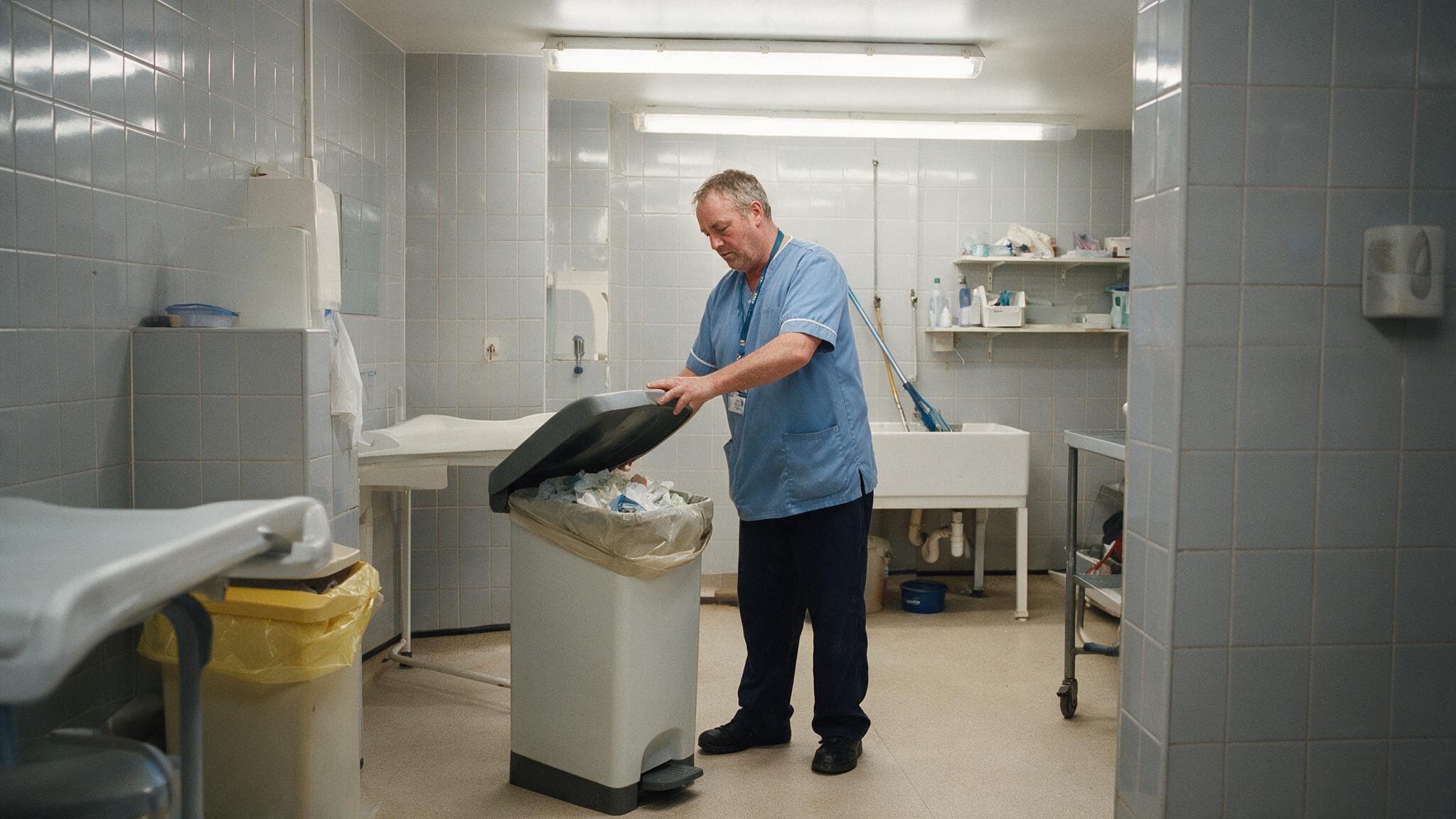
Clinical waste bins run from small bedside containers of a few litres up to wheeled units of 770 litres and beyond. The colour coding tells you what goes in. The size and siting decide whether the right thing actually happens, and those get far less attention.
Most settings need at least three of these. A single size everywhere means either bedside bins that are far too big or a store bin that has to be emptied constantly.
A bin that takes six weeks to fill holds clinical waste for six weeks. That is an odour problem, a pest problem and, depending on the content, an infection control problem. It also means the bag sits open and handled for far longer than necessary.
Match the size so that a bin fills in a few days at the point of use, and within the interval between contractor collections at the storage point. If a bin is routinely being sealed at a quarter full simply because time has passed, it is too big for that location and you are paying to dispose of mostly air.
A bin that is always full does not stop waste being generated. It causes waste to be put somewhere else: into the domestic bin, on top of the lid, or into whichever bin has space regardless of its colour. Segregation failures usually trace back to a bin that was full at the moment someone needed it, not to staff not knowing the colour codes.
If you find the wrong waste in a bin regularly, look at capacity and position before you look at training. Retraining people to use a bin they cannot reach or that is already full does not work.
Waste goes into the nearest container. That is not laziness, it is how people behave when their hands are full and possibly contaminated. Put the right bin within arm's reach of where the waste is generated and the segregation problem largely solves itself.
A pedal-operated lid keeps contaminated hands off the bin. It is also the part that fails first, so it is worth buying a bin whose pedal mechanism can be replaced rather than one where a broken pedal means a new bin. Where a pedal is broken, people prop the lid open, which defeats the point entirely.
Fire-retardant bins are worth specifying in corridors, plant rooms and anywhere a discarded ignition source is plausible. It is a small premium against a real risk.
Work backwards from the collection schedule. If a contractor collects weekly, the store must hold a week of waste plus a margin, with enough space to move full containers without dragging them past each other. A store that is exactly the right size on paper becomes unworkable the week a collection is missed.
Keep the store secure and signed, and keep a route from the building that does not pass through a clean area or a public space where that can be avoided.
Walk the building and note, at each bin: how full it is, when it was last changed, and whether anything is in it that should not be. Then note how far it is from where that waste is actually produced. Most segregation problems become obvious within an hour, and most of them are a siting or sizing decision rather than a behaviour one.
From our catalogue

Delivery as soon as Tuesday 15 September
Inc. VAT

Delivery as soon as Tuesday 15 September
Inc. VAT

Delivery as soon as Tuesday 15 September
Inc. VAT

Delivery as soon as Tuesday 15 September
Inc. VAT