Buyer's Guides
Pharmacy Fridges and Cold Chain: Monitoring That Holds Up
The fridge is rarely the problem. The record of what the fridge did is where most cold chain failures actually show up.
OMS Clinical Team
Product Specialists
Buyer's Guides
The fridge is rarely the problem. The record of what the fridge did is where most cold chain failures actually show up.
OMS Clinical Team
Product Specialists
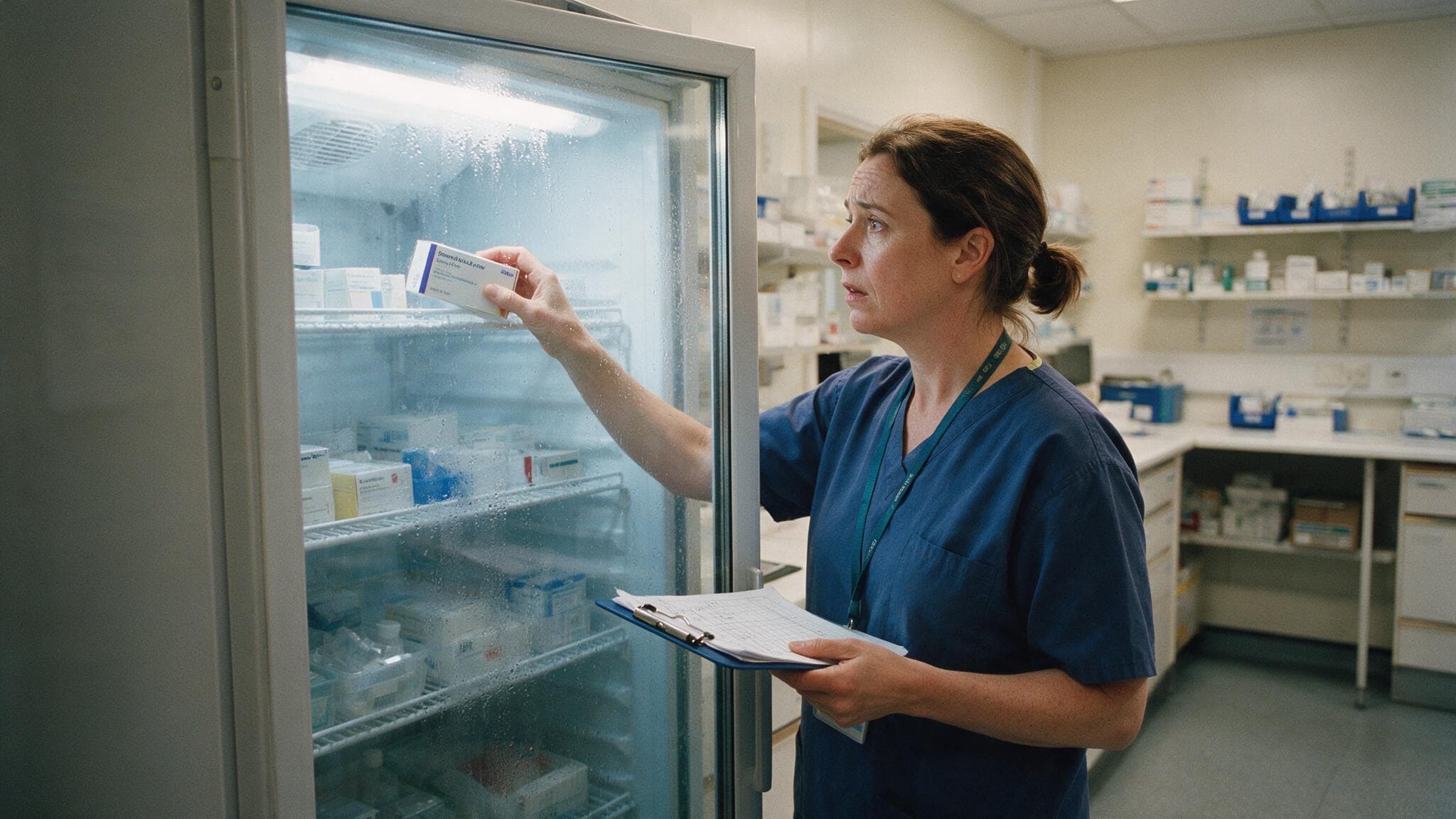
A pharmacy refrigerator holds medicines between 2 and 8 degrees Celsius. What matters almost as much is being able to show it did, continuously, for the whole period the stock was held. An inspector asking about cold chain is usually asking about the record.
A medical refrigerator differs from a domestic one in ways that matter. It holds a tighter temperature band, it recovers faster after the door opens, it circulates air so the temperature is even rather than stratified, and it has a calibrated display and an alarm. A domestic fridge can sit at 2 to 8 on average while spending part of every cycle below zero at the back, which freezes vaccines.
Record minimum and maximum, not just the current reading. A fridge showing 5 degrees now tells you nothing about the night. The minimum and maximum since the last reset is what shows whether stock stayed in range.
Read and reset once every working day at a minimum, and record the reading, the date, the time and who took it. A log with dates but no names is weaker evidence than one with both. Gaps for weekends and bank holidays are normal and expected, provided a data logger covers the interval.
A continuous logger records at intervals whether or not anyone is present, which covers nights, weekends and closures. It also gives you the shape of an excursion rather than a single number: a brief spike when the door was open is a different problem from six hours at 12 degrees.
Choose one that can be downloaded and stored. A logger whose data cannot be exported gives you a reading but not a record.
Do not discard stock reflexively, and do not return it to use reflexively either. Isolate and quarantine the affected stock, record what happened including the duration and the temperatures reached, and seek advice from the manufacturer or the relevant medicines information service before deciding. Many products tolerate short excursions; some tolerate none.
Do not overfill. Air needs to circulate, and a packed fridge develops warm pockets. Keep stock away from the back wall and off the floor of the cabinet. Do not store anything in the door of a medical fridge. Let staff know that propping the door while restocking is the most common cause of an avoidable excursion.
A medical fridge next to a radiator, in direct sun, or crammed against a wall with no clearance will work harder, cycle more and fail sooner. Most need a gap at the back and sides for the condenser to shed heat. A fridge in a stockroom that reaches 30 degrees in summer is being asked to do something it was not specified for.
Give it a dedicated socket that cannot be switched off with the lights, and label that socket clearly. Unplugging the fridge to run a vacuum cleaner over a weekend is a genuine and entirely preventable way to lose a full cabinet of stock.
A calibrated display is only meaningful if the calibration is current. Thermometers and probes drift, and a certificate from three years ago is not evidence for today. Set a calibration interval, keep the certificates, and treat an out-of-calibration probe as an excursion of unknown size rather than assuming everything was fine.
On installation, or after a move, it is worth mapping the cabinet: place loggers at the top, bottom, back and door end and run it loaded for a few days. That tells you where the warm and cold spots are, so you know which shelf not to put vaccines on.
From our catalogue

Delivery as soon as Tuesday 15 September
Inc. VAT

Delivery as soon as Tuesday 15 September
Inc. VAT

Delivery as soon as Tuesday 15 September
Inc. VAT

Delivery as soon as Tuesday 15 September
Inc. VAT