Buyer's Guides
Prescription Bags and Tamper-Evident Seals: What to Use
A bag that splits on the walk home is a dispensing error the patient blames on you. Size and seal choice are less trivial than they look.
OMS Clinical Team
Product Specialists
Buyer's Guides
A bag that splits on the walk home is a dispensing error the patient blames on you. Size and seal choice are less trivial than they look.
OMS Clinical Team
Product Specialists
Prescription bags are sized by height, width and gusset, quoted in that order in millimetres. The gusset is the fold at the base that lets the bag open out. Get the gusset wrong and a bag that looks big enough on paper will not take a boxed inhaler.
A bag described as 215 x 75 x 50mm is 215mm tall, 75mm wide and has a 50mm gusset. The common NHS sizes run from around 215mm tall for single small boxes up to 350mm for bulky or multiple items. Most pharmacies settle on three sizes: a small for single boxes, a medium for typical multi-item prescriptions, and a large for bulk or awkward shapes.
Ordering only one size is a false economy. Small items rattling around a large bag look careless, and forcing a box into a bag that is slightly too small is how bags split.
Brown kraft paper has largely replaced plastic for prescription bags in UK pharmacy. It is recyclable, it takes a label cleanly, and it does not sweat in the way a sealed plastic bag can. The trade-off is wet weather. If your patients walk home, a paper bag in rain is a genuine problem, and it is worth keeping some plastic or a rain cover for that.
A tamper-evident seal does not prevent tampering. It makes tampering visible. That distinction matters when you decide where to use one. The seal shows that the bag has been opened between the point it was sealed and the point it was handed over, which is useful for deliveries, for collections by someone other than the patient, and for anything travelling between sites.
Uniquely numbered seals go a step further. Recording the number against the dispensing record means you can show which specific seal was on which specific bag. That is worth doing for controlled drugs, for high-value items and for anything where a dispute is plausible.
For a routine over-the-counter collection where the patient is standing in front of you, a seal adds cost and time for very little. Use them where the bag leaves your sight.
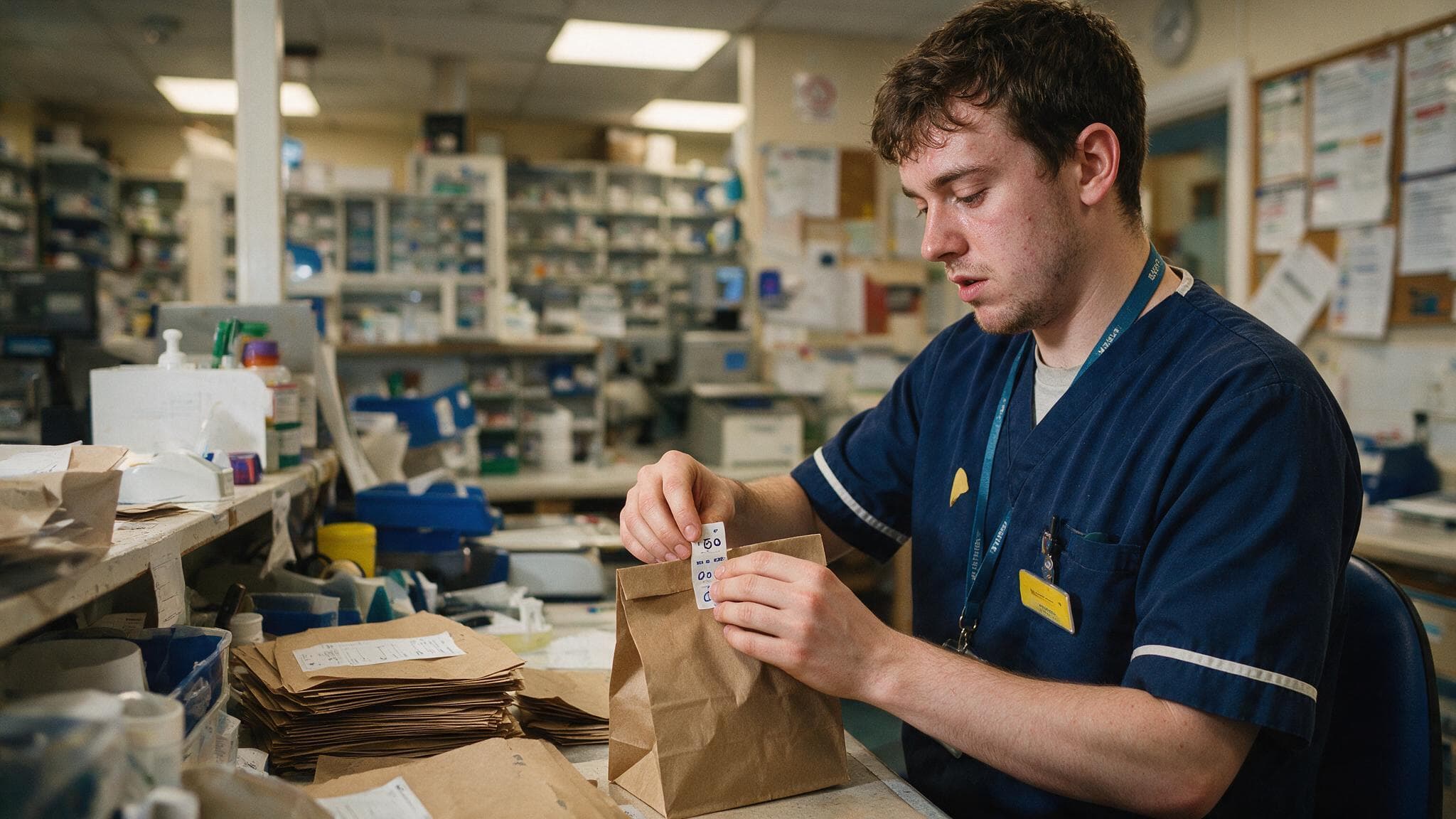
Seals stick better to paper than to plastic, and better to a flat surface than a fold. Apply across the closure so that opening the bag breaks the seal rather than peeling it. If you are using numbered seals, log the number at the point of sealing, not later from memory.
Keep one size of bag in easy reach of the bagging station and the others nearby. Reaching for the wrong size because it is closer is how mixed stock ends up unbalanced.
From our catalogue

Delivery as soon as Tuesday 15 September
Inc. VAT

Delivery as soon as Tuesday 15 September
Inc. VAT

Delivery as soon as Tuesday 15 September
Inc. VAT

Delivery as soon as Tuesday 15 September
Inc. VAT