Found a Discarded Needle at Work? Who Should Pick It Up, and How
There are two right answers when a used needle turns up at work. Most injuries happen when someone who should have called the council picks it up instead.
A used needle turns up in a stairwell, behind a toilet cistern, in a car park or in a flower bed outside the entrance. Someone has to decide what happens next, usually in the next few seconds, and usually without having thought about it before.
There are two right answers, and which one applies depends on who finds it. A member of the public, or a member of staff whose job does not include this, should leave it where it is and report it. A worker whose employer expects needles to turn up should have the equipment and a procedure to remove it safely. Most injuries happen when someone in the first group acts as if they were in the second.
If it is not your job: leave it and report it
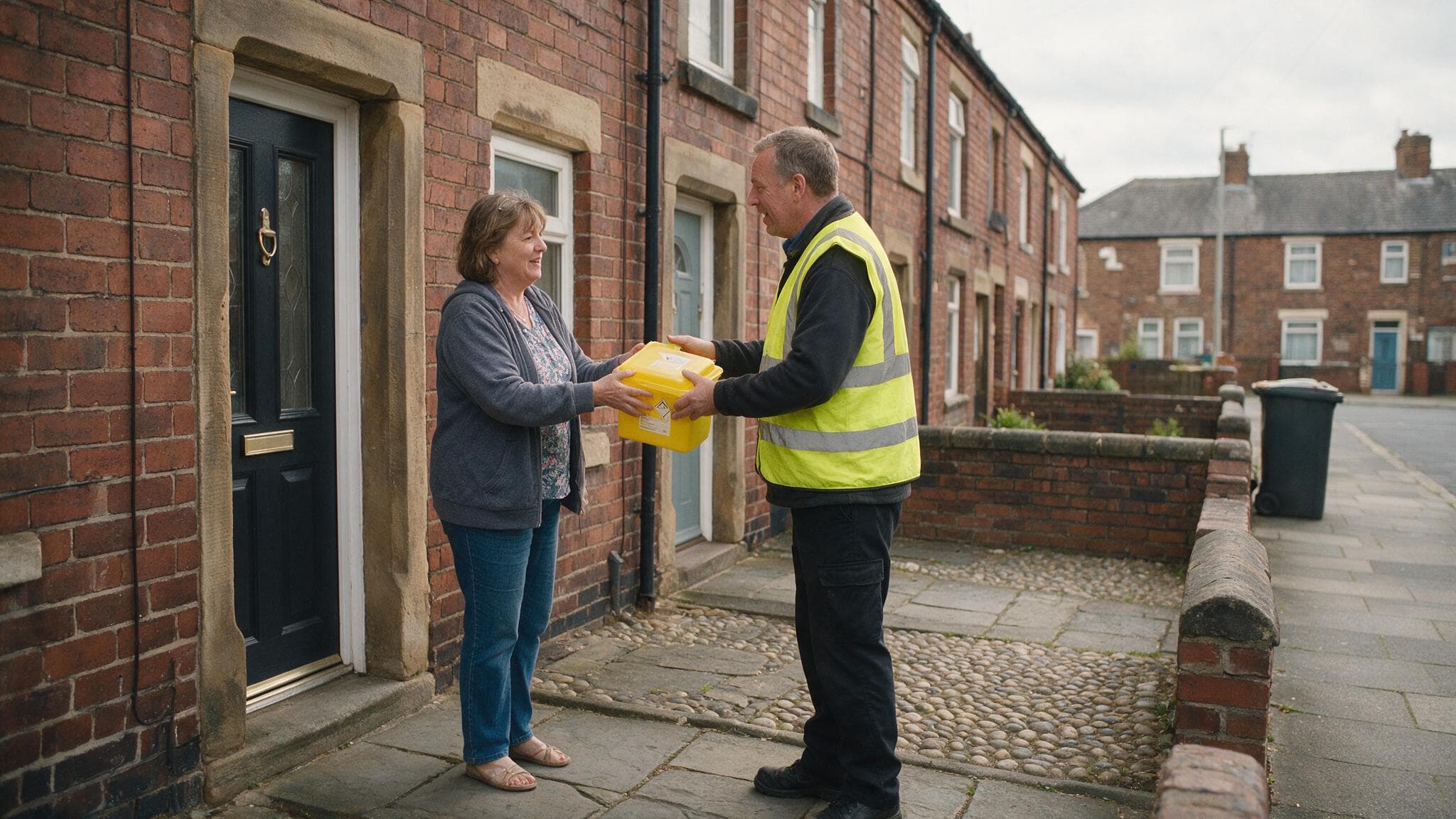
HSE is direct about needles found in public places. Its guidance on avoiding sharps injuries notes that needles and syringes collected in public places have been shown to be a source of blood-borne virus contamination, and says: "Never handle these materials". Instead, it says, you must inform the local authority and request a clinical waste collection.
In practice that means four things:
Do not touch it, move it, cover it with anything you might later pick up, or try to push it into a bin
Keep people away, and children and dogs in particular, until it has been removed
Note exactly where it is, so the person who comes to remove it can find it quickly
Report it to your local council, or to your manager or facilities team if it is on your employer's premises
Councils treat this as routine work. Hull City Council, for example, removes needles found on roads, pavements and parks and aims to do so within 24 hours. Response times vary by area, so check your own council's website for how to report one.
If it is your job: an employer's procedure comes first
For some workplaces a discarded needle is not a surprise. Housing and hostel staff, cleaners, caretakers, park and grounds teams, public toilet attendants, hospitality and retail staff, and vehicle repair workers all find them. HSE recognises this in its guidance on blood-borne viruses: discarded needles are a potential source of contamination and "workers may have to deal with them", so care should be taken to retrieve and dispose of them in a way that avoids sharps injuries.
HSE's guidance on blood-borne viruses sits under COSHH, the regulations covering hazardous substances including biological agents. The practical result is the same for any employer where needles are a foreseeable find: assess the risk, decide who removes them and who does not, give those people the right equipment, and train them before the first one turns up rather than after.
A good procedure answers a handful of plain questions. Who is allowed to pick a needle up? Where is the kit kept, and who checks it is complete? Where does the filled container go? Who is told when someone is injured, and who takes them for treatment? If staff cannot answer those on the spot, the procedure is not working yet.
What a needle clean-up kit needs
The kit is small and inexpensive, and the single most important item is the one people most often skip: something to pick the needle up with that is not a hand.
Tongs or long tweezers, so fingers never go near the point. HSE lists tongs as a precaution for needles found in vehicles, and councils give the same advice for needles found outside
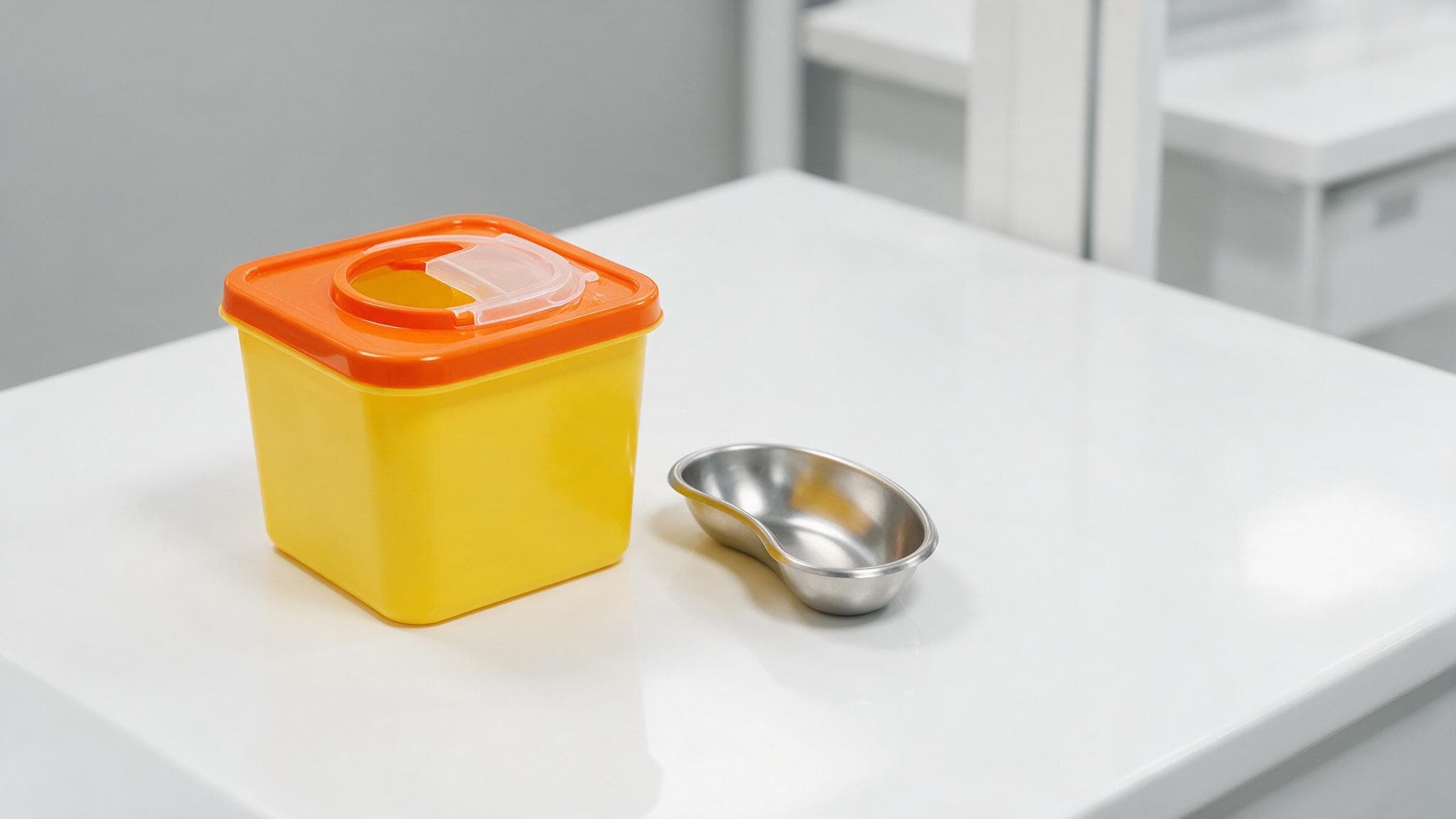
A rigid sharps container with a lid that closes. A small yellow bin such as a 1 litre Sharpsguard or 2.5 litre Sharpsguard is designed to be carried to where the needle is
Gloves. Hull City Council suggests rubber or thick leather gloves. Disposable nitrile gloves protect against blood on the syringe, not against the point, so they do not replace tongs
Hand washing or sanitiser for afterwards, and a torch for dark corners, stairwells and vehicle footwells
A short copy of the procedure, including what to do after an injury, kept with the kit
For choosing between glove materials, see our guide to nitrile, latex and vinyl gloves. For the difference between yellow, orange, purple and blue lidded containers, see sharps bins explained. A found needle of unknown origin goes into the standard yellow container.
The safe pick-up, step by step
These steps are for staff whose employer has a procedure and has trained them. They follow HSE guidance and council practice.
Slow down. A needle that has been there for hours will still be there in two minutes, and rushing is how injuries happen.
Keep other people back from the area, and put on gloves.
Take the container to the needle, not the needle to the container. Open it and place it on a flat, stable surface right next to the needle.
Pick the needle or syringe up with tongs, holding it by the barrel or plunger end with the point facing away from you.
Put it into the container point first, and let go without pushing your hand towards the opening.
Do not put a cap back on the needle, bend it or break it. HSE says needles should not be re-sheathed or re-capped.
Close the lid. Then look carefully around the area, including under leaves, behind pipes and in gaps between surfaces, in case there are more.
Take off the gloves without touching the outside, and wash your hands.
Record where and when it was found, so a pattern can be spotted and the area checked more often.
If someone is pricked
A needlestick injury from a discarded needle needs first aid straight away and medical advice the same day. NHS occupational health guidance, including from Newcastle Hospitals and Mersey West Lancashire, gives the same first aid steps:
Encourage the wound to bleed, ideally under running water
Wash it with soap and plenty of running water
Do not scrub the wound, and do not suck it
Dry it and cover it with a waterproof plaster or dressing
Then get medical advice urgently. At work that means your occupational health service if there is one. Otherwise go to A&E or call NHS 111. Do not leave it until the next morning. Treatment to reduce the risk of HIV after an exposure has to be started as soon as possible, and NHS guidance says it is not given after 72 hours, so the first few hours matter.
The employer should then record the incident, check how it happened and whether the procedure or the kit let the person down. The answer is often simple: the tongs were missing, or the container was left in a different building.
Where the filled container goes
A found needle is clinical waste. It does not go in general waste or recycling, even inside a sealed container. On a business site the container goes out through the same clinical waste arrangement as any other sharps bin, and the business keeps its duty of care over it until it is collected. Our guide to clinical waste collection and duty of care covers how that works.
If a business rarely finds needles and has no clinical waste contract, ask the local council. Many will collect a sealed container, and some accept them at a set drop-off point.
Healthcare and home settings are different
In hospitals, GP surgeries, pharmacies and care services the rules are tighter, because needles are handled every day by design. Those employers fall under the Health and Safety (Sharp Instruments in Healthcare) Regulations 2013, covered in our guide to sharps safety and the 2013 regulations.
For people who use needles at home, such as for diabetes or other injectable medicines, the question is how to dispose of their own sharps rather than what to do with a stranger's. That is covered in sharps disposal at home.
A short checklist for managers
Decide whether needles are a foreseeable find on your premises. If they are, write it into your risk assessment
Name who may remove them, and make sure everyone else knows to leave them and report them
Put together a kit: tongs, a small yellow sharps container, suitable gloves, hand cleaning and the procedure
Keep the kit where it will be needed, and check it after every use
Train the named staff before the first find, including the first aid steps
Agree where filled containers go and who collects them
Record each find, and look at the records for patterns
Frequently asked questions
Should I pick up a needle I find in the street?
No. HSE says never to handle needles found in public places and to inform the local authority instead. Keep people away from it, note where it is and report it to your council.
Can I put a found needle in a plastic bottle?
Only as a last resort, and a proper sharps container is far better. Hull City Council advises a plastic container with a screw top lid if nothing else is available, and warns against glass bottles and drinks cans.
Do gloves protect against a needlestick injury?
Not reliably. Disposable gloves protect against blood on the outside of a syringe but a needle can go straight through them. Tongs or long tweezers are what keep fingers away from the point.
What should I do if I am pricked by a discarded needle?
Encourage the wound to bleed under running water, wash it with soap and water without scrubbing, do not suck it, and cover it with a waterproof dressing. Then get medical advice the same day from occupational health, A&E or NHS 111.
How quickly do I need medical treatment after a needlestick injury?
The same day. Treatment to reduce the risk of HIV has to be started as soon as possible and, according to NHS guidance, is not given after 72 hours. Do not wait until the next morning.
Who removes needles from public land?
Your local council. Most have a reporting line or online form, and many aim to remove needles from public areas quickly. Hull City Council, for example, aims to do it within 24 hours.
Do the Sharps Regulations 2013 apply to my business?
Only if you are a healthcare employer. Other employers where needles are a foreseeable find should cover them in their general risk assessment and give named staff a procedure, a kit and training.
Can a sealed container of found needles go in general waste?
No. It is clinical waste. On business premises it goes out through a clinical waste collection. If you have no contract, ask your local council, as many will collect it.